Atlas Earth e IVA: Perché da oggi giocare costa di più (e i tempi di rientro si allungano)

Per molti giocatori europei di Atlas Earth questo è probabilmente uno degli aggiornamenti più pesanti degli ultimi tempi.
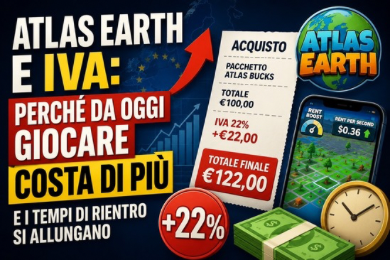
Da maggio 2026, infatti, gli acquisti effettuati tramite Stripe mostrano e applicano l’IVA locale del Paese dell’utente. In Italia significa un aumento immediato del 22% sul costo finale dei pacchetti Atlas Bucks e degli abbonamenti.
E la domanda che molti si stanno facendo è semplice:
ne vale ancora la pena?
Cosa è successo davvero
Atlas Earth non ha aumentato il prezzo base degli Atlas Bucks.
Il cambiamento riguarda la fiscalità applicata agli acquisti digitali effettuati dall’Europa.
I servizi digitali venduti a consumatori europei devono applicare l’IVA del Paese dell’acquirente. Stripe, il sistema utilizzato da Atlas Earth per i pagamenti web, consente di applicare automaticamente l’aliquota fiscale corretta in base alla nazione dell’utente.
Nel frattempo, l’Unione Europea ha approvato il pacchetto ViDA (VAT in the Digital Age), una riforma che punta a rafforzare il controllo fiscale e la digitalizzazione dell’IVA nel settore online. Il pacchetto è stato adottato ufficialmente l’11 marzo 2025 e verrà implementato progressivamente fino al 2035.
In pratica, il settore dei pagamenti digitali sta diventando molto più rigido e automatizzato nella gestione delle tasse.
E il risultato finale è semplice:
da oggi i giocatori italiani pagano il 22% in più sugli acquisti web.
Il problema vero: il ROI peggiora drasticamente
Qui però arriva la parte più importante.
Atlas Earth è un gioco dove molti utenti ragionano in termini di ROI, cioè di tempo necessario per recuperare la spesa effettuata tramite la rendita generata dai terreni.
E se il costo aumenta del 22%, anche il tempo di rientro aumenta automaticamente.
Non di poco.
Quanto peggiorano i tempi di rientro
Per capire davvero quanto cambia la situazione bisogna guardare il dato più importante:
quanto costa realmente un terreno e quanti anni servono per recuperarlo con la rendita generata.
Per questi calcoli consideriamo una rendita media di circa 0,36$ l’anno per terreno. Con il passaporto completo si può arrivare intorno a 0,39$ annui, ma è una situazione che riguarda una minoranza dei giocatori.
Prendiamo quindi tre dei metodi più utilizzati su Atlas Earth:
- Season Pass mensile;
- Explorer Club mensile;
- pacchetto Atlas da 100$ con 2550 AB.
Con l’IVA italiana del 22%, i numeri cambiano così:
| Metodo | Costo terreno prima | Costo terreno con IVA | Tempo rientro prima | Tempo rientro con IVA |
|---|---|---|---|---|
| Season Pass Monthly | 0,94$ | 1,15$ | 2,6 anni | 3,2 anni |
| Explorer Club Monthly | 1,38$ | 1,68$ | 3,8 anni | 4,6 anni |
| Pacchetto Atlas 100$ — 2550 AB | 3,92$ | 4,78$ | 10,9 anni | 13,3 anni |
Ed è qui che il problema diventa molto più serio di quanto sembri.
Perché il Season Pass, che prima riusciva a recuperarsi mediamente in circa 2 anni e mezzo, ora supera tranquillamente i 3 anni.
Explorer Club, che per molti rappresentava il miglior compromesso tra crescita e convenienza, passa invece da circa 3,8 anni a quasi 5 anni di recupero.
Ma il dato più impressionante riguarda i classici pacchetti Atlas.
Un pacchetto da 100$ che fornisce 2550 AB permetteva prima di acquistare terreni con un costo medio di circa 3,92$ a parcella.
Con l’IVA italiana del 22%, lo stesso pacchetto arriva a costare circa 122$.
Il costo reale di ogni terreno sale quindi vicino ai 4,80$.
E considerando una rendita media di circa 0,36$ l’anno per terreno, il tempo di recupero passa da circa 11 anni a oltre 13 anni.
Praticamente un orizzonte temporale enorme per un gioco mobile.
E tutto questo senza considerare:
- eventuali modifiche future ai booster;
- cambiamenti economici del gioco;
- oscillazioni del dollaro;
- inflazione;
- tasse future;
- rischio piattaforma.
La rendita dei terreni infatti non aumenta.
Aumenta soltanto il capitale necessario per acquistarli.
Gli abbonamenti diventano molto meno convenienti
La situazione è ancora più delicata sugli abbonamenti.
Molti utenti accettavano Atlas Explorer Club perché permetteva di accumulare Atlas Bucks con una convenienza interessante rispetto agli acquisti singoli.
Ma con l’aggiunta dell’IVA il costo reale dell’abbonamento sale immediatamente del 22%.
Un abbonamento da 50$ diventa circa 61$.
Su base annuale significa oltre 130 dollari in più.
E qui nasce il vero problema:
Atlas Earth è un gioco con rendimenti già piuttosto lenti.
Aumentare del 22% il capitale necessario peggiora enormemente il rapporto tra investimento e ritorno economico.
Il colpo psicologico sui giocatori europei
C’è poi un altro aspetto molto importante: quello psicologico.
Fino a oggi molti giocatori percepivano gli acquisti web come “più convenienti” rispetto ad App Store e Google Play.
Ora invece si trovano improvvisamente davanti a prezzi molto più alti al checkout.
Anche se tecnicamente il prezzo base non è cambiato, la percezione dell’utente cambia completamente.
E nei giochi mobile la percezione conta tantissimo.
Conviene ancora investire soldi su Atlas Earth?
Questa è la domanda più difficile.
La risposta dipende dal motivo per cui si gioca.
Se si gioca per divertimento
Allora probabilmente sì.
Atlas Earth rimane un gioco originale, diverso dai classici mobile game, con una componente territoriale e competitiva ancora molto interessante.
In questo caso l’IVA cambia poco: il denaro speso viene vissuto come intrattenimento.
Se invece si gioca pensando al ritorno economico
Allora il discorso cambia parecchio.
I tempi di rientro erano già lunghi prima.
Con un aumento immediato del 22% del capitale necessario, il ROI peggiora sensibilmente e diventa ancora più lento recuperare gli acquisti effettuati.
E qui probabilmente molti utenti inizieranno a guardarsi intorno anche verso alternative differenti.
Negli ultimi mesi, per esempio, abbiamo iniziato ad analizzare anche sistemi come GoMining, che hanno una logica completamente diversa rispetto ad Atlas Earth e tempi di recupero molto differenti.
Questo non significa che Atlas Earth “non paghi”.
Ma significa che da oggi serve molta più prudenza nel valutare gli acquisti.
La vera conseguenza: molti utenti rallenteranno gli acquisti
La sensazione è che questa novità possa cambiare il comportamento di molti giocatori europei.
Probabilmente vedremo:
- meno acquisti impulsivi;
- più attenzione al ROI reale;
- maggiore utilizzo del gioco in modalità free-to-play;
- più dubbi sugli abbonamenti mensili;
- crescita più lenta degli account europei.
E questo potrebbe avere un impatto concreto sull’economia del gioco nel lungo periodo.
Sensazioni
L’aggiunta dell’IVA non è soltanto un piccolo aumento di prezzo.
Per un gioco basato sulla crescita progressiva della rendita, il 22% in più cambia completamente il rapporto tra spesa e ritorno economico.
I tempi di rientro si allungano.
Gli abbonamenti diventano meno convenienti.
Il capitale necessario aumenta sensibilmente.
Atlas Earth rimane un gioco divertente e ancora unico nel suo genere.
Ma da oggi, per chi investe soldi reali, diventa molto più importante fare bene i conti prima di acquistare.
For many European Atlas Earth players, this is probably one of the heaviest updates in recent times.
Starting in May 2026, purchases made through Stripe now show and apply the local VAT of the user’s country. In Italy, that means an immediate 22% increase on the final cost of Atlas Bucks packages and subscriptions.
And the question many players are now asking is simple:
is it still worth it?
What actually happened
Atlas Earth has not increased the base price of Atlas Bucks.
The change is related to taxation applied to digital purchases made from Europe.
Digital services sold to European consumers must apply the VAT rate of the buyer’s country. Stripe, the payment system used by Atlas Earth for web purchases, allows companies to automatically apply the correct tax rate based on the user’s location.
Meanwhile, the European Union has approved the ViDA package, VAT in the Digital Age, a reform designed to strengthen tax control and VAT digitalization in the online sector. The package was officially adopted on March 11, 2025, and will be implemented progressively until 2035.
In practice, digital payments are becoming much stricter and more automated when it comes to tax management.
And the final result is simple:
Italian players now pay 22% more on web purchases.
The real problem: ROI gets much worse
This is where things become much more important.
Atlas Earth is a game where many users think in terms of ROI, meaning the time needed to recover the money spent through the rent generated by parcels.
And if the cost increases by 22%, the payback time automatically increases too.
And not by a little.
How much payback times actually get worse
To understand how much the situation changes, we need to look at the most important number:
how much a parcel really costs and how many years it takes to recover that cost through rent.
For these calculations, we use an average yearly rent of around $0.36 per parcel. With a complete passport, this can rise to around $0.39 per year, but that only applies to a minority of players.
So let’s take three of the most common purchase methods in Atlas Earth:
- Monthly Season Pass;
- Monthly Explorer Club;
- $100 Atlas package with 2550 AB.
With Italy’s 22% VAT, the numbers change like this:
| Method | Parcel cost before | Parcel cost with VAT | Payback before | Payback with VAT |
|---|---|---|---|---|
| Season Pass Monthly | $0.94 | $1.15 | 2.6 years | 3.2 years |
| Explorer Club Monthly | $1.38 | $1.68 | 3.8 years | 4.6 years |
| $100 Atlas Package — 2550 AB | $3.92 | $4.78 | 10.9 years | 13.3 years |
This is where the problem becomes much more serious than it may seem at first.
The Season Pass, which previously paid itself back in roughly two and a half years, now easily goes above 3 years.
Explorer Club, which many players considered the best compromise between growth and value, goes from around 3.8 years to almost 5 years of payback time.
But the most striking number comes from the classic Atlas packages.
A $100 package that gives 2550 AB previously allowed players to buy parcels at an average cost of about $3.92 each.
With Italy’s 22% VAT, that same package costs about $122.
The real cost of each parcel therefore rises close to $4.80.
And considering an average yearly rent of around $0.36 per parcel, the payback time goes from around 11 years to more than 13 years.
That is an extremely long time horizon for a mobile game.
And this does not even include:
- possible future changes to boosts;
- changes to the game economy;
- USD exchange rate fluctuations;
- inflation;
- future taxes;
- platform risk.
The rent generated by parcels does not increase.
Only the capital needed to buy them increases.
Subscriptions become much less attractive
The situation is even more delicate when it comes to subscriptions.
Many users accepted Atlas Explorer Club because it allowed them to accumulate Atlas Bucks more efficiently than direct purchases.
But with VAT added, the real cost of the subscription immediately rises by 22%.
A $50 subscription becomes about $61.
On a yearly basis, that means more than $130 extra.
And this is the real issue:
Atlas Earth is already a game with fairly slow returns.
Increasing the required capital by 22% significantly worsens the balance between money spent and money earned back.
The psychological hit for European players
There is also another important factor: psychology.
Until now, many players perceived web purchases as “better value” compared to App Store and Google Play purchases.
Now they suddenly see much higher prices at checkout.
Even if the base price has technically not changed, the user’s perception changes completely.
And in mobile games, perception matters a lot.
Is it still worth investing money in Atlas Earth?
This is the hardest question.
The answer depends on why you play.
If you play for fun
Then probably yes.
Atlas Earth remains an original game, different from most mobile games, with a territorial and competitive component that is still very interesting.
In this case, VAT changes little: the money spent is simply entertainment.
If you play with ROI in mind
Then the picture changes a lot.
Payback times were already long before.
With an immediate 22% increase in the required capital, ROI becomes significantly worse and purchases take even longer to recover.
At this point, many users will probably start looking at different alternatives.
In recent months, for example, we have also started analyzing systems like GoMining, which works very differently from Atlas Earth and has very different payback dynamics.
This does not mean that Atlas Earth “does not pay”.
It simply means that from now on, players need to be much more careful when evaluating purchases.
The real consequence: many users will slow down their purchases
The feeling is that this change may alter the behavior of many European players.
We will probably see:
- fewer impulse purchases;
- more attention to real ROI;
- more users playing free-to-play;
- more doubts about monthly subscriptions;
- slower growth for European accounts.
And this could have a real impact on the game’s internal economy over time.
Conclusion
The addition of VAT is not just a small price increase.
For a game based on the gradual growth of rent, an extra 22% completely changes the relationship between spending and returns.
Payback times get longer.
Subscriptions become less attractive.
The required capital increases significantly.
Atlas Earth remains a fascinating game and still a unique project.
But from now on, anyone investing real money needs to do the math very carefully before buying.